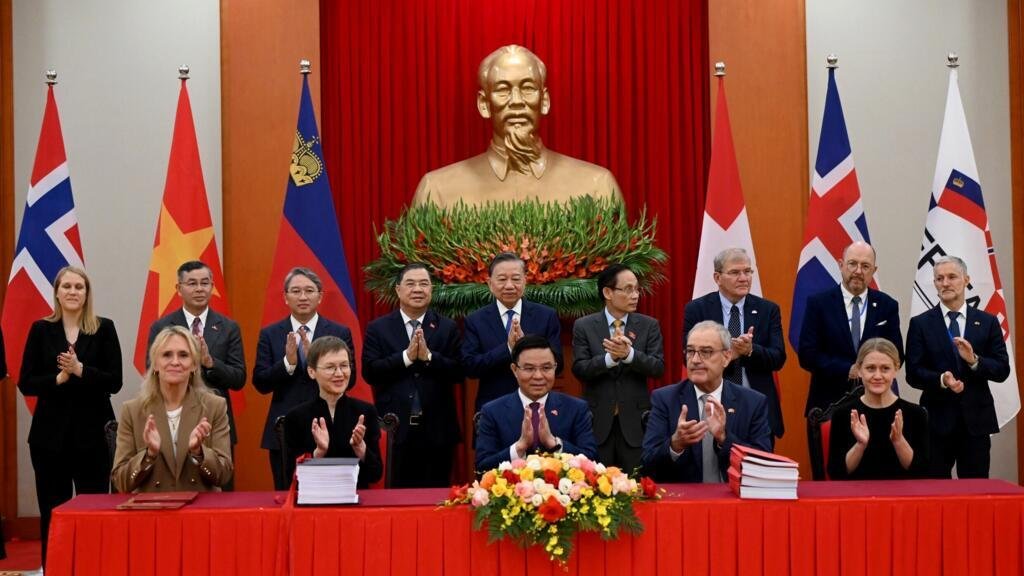
HANOI, October 18, 2026 (DAILYNWZ) — Vietnam has signed a free-trade agreement with Norway, Switzerland, Iceland and Liechtenstein, opening the way for lower tariffs on goods traded with the four European countries as governments seek to strengthen commercial ties amid global trade tensions.
Vietnam’s trade ministry said the agreement was signed in Hanoi with the four members of the European Free Trade Association (EFTA). The Norwegian government also announced the deal on Sunday.
The agreement is expected to give Norwegian exporters greater access to the Vietnamese market. Around half of Norway’s exports to Vietnam will enter duty-free once the pact takes effect, with the share rising to more than 98% within seven years, according to the Norwegian government.
The deal follows the revival of long-stalled negotiations last year, as uncertainty over global trade intensified amid US tariff measures. Talks concluded in July, paving the way for the agreement.
The pact covers trade between Vietnam and the four EFTA members, whose commercial relationship with the Southeast Asian economy spans a range of industrial and consumer goods.
Vietnam’s main exports to EFTA markets include seafood, footwear, textiles, machinery and equipment, electronics, and electronic components, the trade ministry said. In return, Vietnam imports industrial machinery and equipment, chemicals, pharmaceuticals and raw materials used in manufacturing.
Bilateral trade between Vietnam and EFTA member countries has averaged $2 billion a year, according to the ministry. The agreement is intended to expand commercial opportunities by reducing trade barriers and improving market access.
The Norwegian government’s tariff figures point to a phased opening of the Vietnamese market for its exporters, with further reductions extending over seven years after the agreement enters into force. The governments have not yet provided an entry-into-force date in the announcements cited.
For Vietnam, the agreement adds another trade framework with European partners as the country maintains its role in regional and global supply chains. Its export mix includes both labor-intensive products, such as footwear and textiles, and higher-value goods, including electronics and machinery.
The pact’s practical impact will depend on when it takes effect and how businesses use the new market access provisions. The two sides have concluded negotiations and signed the agreement, but the announced tariff schedule will be implemented only once it enters into force.