
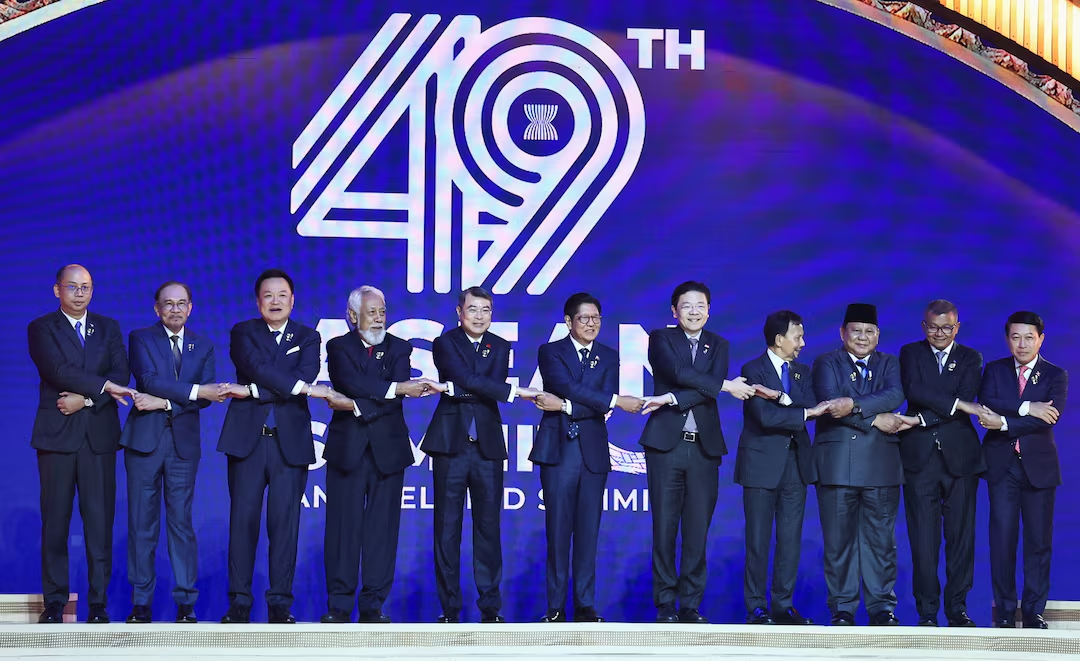
MANILA, November 15, 2026 (DAILYNWZ) — Southeast Asian leaders have agreed to keep Myanmar’s military-backed government excluded from high-level regional meetings while opening the door to restoring its full political representation if it makes sustained progress towards resolving the country’s five-year crisis.
The decision, adopted at the Association of Southeast Asian Nations (ASEAN) summit in Manila on Sunday, maintains restrictions on Myanmar’s participation in leaders’ summits and foreign ministers’ meetings but introduces a potential path towards gradual reintegration.
In a joint statement, the 11-member bloc said it could consider restoring Myanmar’s full political representation if the country demonstrates “sustained and concrete” progress in implementing ASEAN’s five-point consensus (5PC), its framework for ending the crisis.
The leaders agreed to pursue what they described as “calibrated engagement”, based on a phased approach tied to measurable progress rather than an immediate lifting of restrictions.
In a notable shift, ASEAN also encouraged individual member states to pursue direct engagement with Myanmar’s various stakeholders, in consultation with the bloc’s rotating chair, to advance implementation of the agreement.
“Subject to sustained and concrete progress in the implementation of the 5PC by Myanmar, ASEAN may consider the gradual restoration of Myanmar’s full political representation,” the leaders said in their joint decision.
The statement also backed efforts by individual members to promote substantive progress through constructive engagement with all relevant parties.
The move comes as Thailand and several other ASEAN countries have intensified bilateral contacts with Myanmar in recent months, increasing pressure within the bloc to reconsider its restrictions on the country’s military-backed leadership.
ASEAN adopted its five-point consensus shortly after Myanmar’s military seized power in February 2021. The plan calls for an immediate end to violence, constructive dialogue among all parties, mediation by ASEAN and the provision of humanitarian assistance.
However, implementation has made little progress amid continued fighting between the military and opposition forces.
Myanmar has remained in turmoil since the military ousted the elected government of Nobel Peace Prize laureate Aung San Suu Kyi, triggering a civil war. The United Nations estimates that the conflict has killed 100,000 people and displaced more than 3.5 million.
The military-backed administration, led by coup leader-turned-president Min Aung Hlaing, has sought to normalise relations with ASEAN and gain wider international acceptance.
It has received support from China, India and Russia, while its international engagement has expanded in recent months. This has included secret talks with US officials as President Donald Trump’s administration reverses years of isolation.
Sunday’s decision reflects ASEAN’s attempt to balance continued pressure on Myanmar’s military authorities with growing calls among some members for renewed engagement. However, any restoration of full political representation remains conditional on concrete progress under the bloc’s peace plan.