
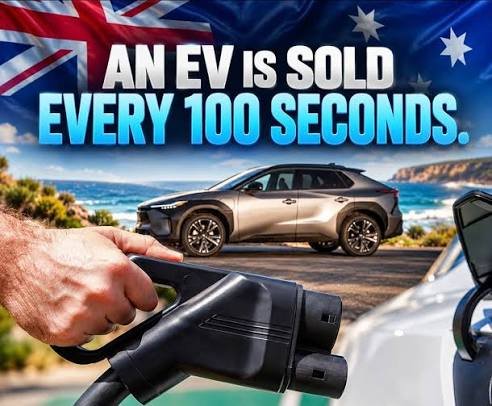
CANBERRA, October 01, 2026 (DAILYNWZ) — Electric vehicle sales in Australia surged 117% in the first half of 2026, reaching a record 157,957 as households increasingly turned to cheaper-to-run cars amid an ongoing fuel crisis, according to a report from the Electric Vehicle Council.
The figure means roughly one EV was sold every 100 seconds between January and June. By contrast, sales of petrol and diesel vehicles fell 14% from a year earlier, the council said.
EVs accounted for one in four new vehicles sold in the first six months of the year, up from 12.1% in the same period of 2025. About 104,000 were battery-electric vehicles and 54,000 were plug-in hybrids.
Julie Delvecchio, chief executive of the Electric Vehicle Council, said the shift was increasingly being driven by household budgets.
“EVs are being taken up as a cost-of-living measure by households across Australia,” she said, adding that the fuel crisis had accelerated adoption but was “not the starting gun.”
The crisis, she said, had instead made the benefits of earlier policy measures more visible, particularly lower running costs and greater energy security.
Australia had 612,000 EVs in its vehicle fleet by June, putting the country on track, according to Aman Gaur, the council’s head of policy and advocacy, to reach one million EVs on its roads by next year.
The Australian Capital Territory remained the country’s strongest EV market, with electric vehicles accounting for 44% of new registrations. Tarneit, in western Melbourne, recorded the highest uptake among individual postcodes.
A national vehicle efficiency standard has also helped expand the market by requiring automakers to meet average emissions targets for new vehicles. Gaur said the rules had “substantially increased the options and the price competitiveness of EVs,” with nearly 200 models available in Australia in 2026.
The council wants the federal government to extend the standard beyond 2029, linking it to the government’s target of cutting emissions by 2035.
Charging infrastructure has broadly kept pace with demand. The number of public charging locations rose to 4,268 nationwide, according to the report.
The transition is less advanced in heavier road transport. Electric trucks and vans still account for less than 1% of their respective markets, leaving a large gap with passenger cars and buses.
“Every truck that is electric is an upgrade to Australia’s energy security,” Delvecchio said. “We’ve barely touched the sides on that transition.”
The report also pointed to widening differences between states and territories. It described federal, Australian Capital Territory and New South Wales policies as “top of the class”, while saying South Australia, Queensland, Tasmania and the Northern Territory had moved backwards.
Gaur singled out Queensland’s recent investment in 630 diesel buses, saying they could remain on the state’s roads until the end of the next decade, including during the Brisbane Olympics.