
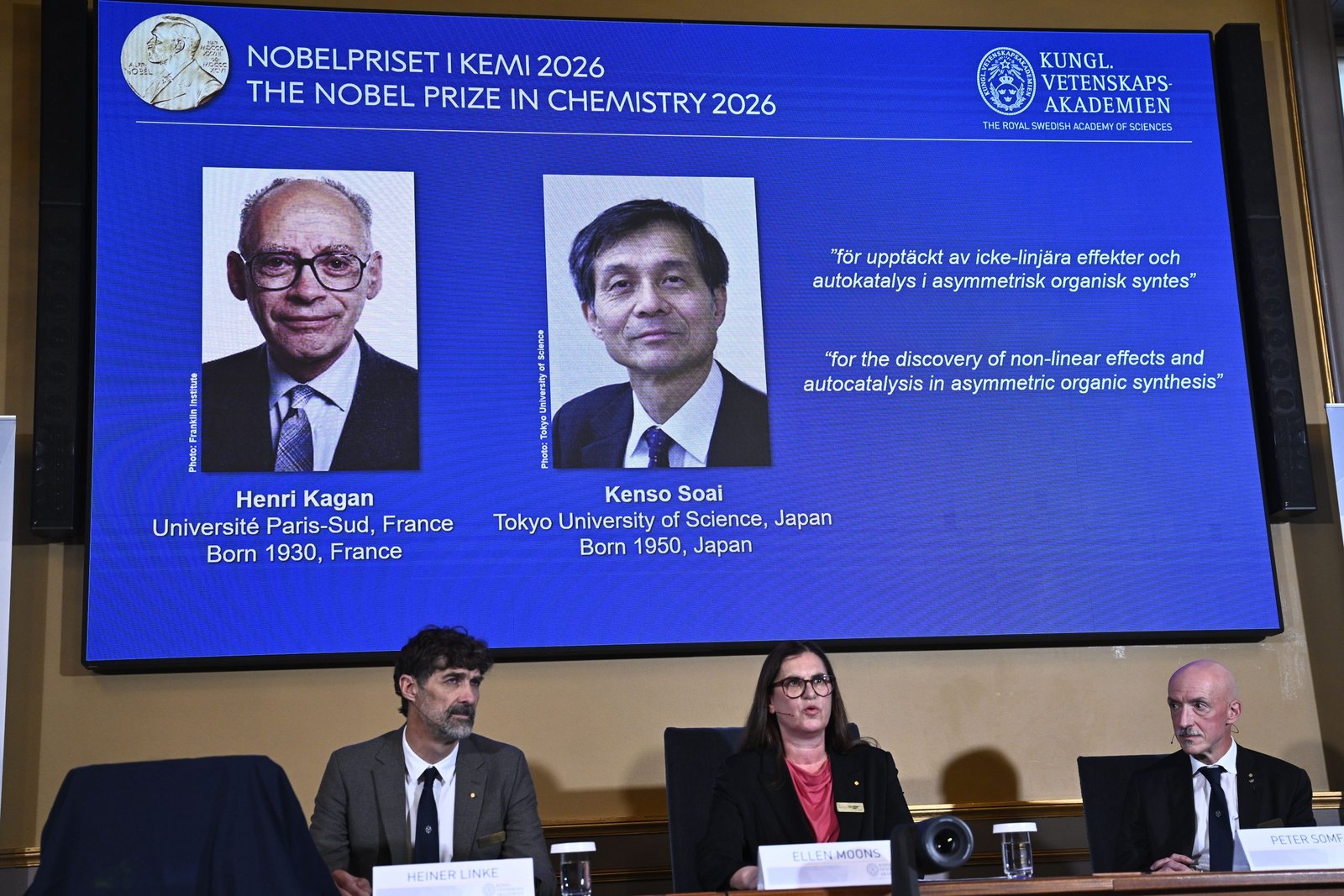
STOCKHOLM, October 07, 2026 (DAILYNWZ) — French scientist Henri B. Kagan and Japanese scientist Kenso Soai won the 2026 Nobel Prize in Chemistry on Wednesday for discoveries that explained how chemical reactions can be directed toward producing a single mirror-image form of a molecule, work with major implications for drug development and manufacturing.
The Royal Swedish Academy of Sciences honored the two scientists “for the discovery of non-linear effects and autocatalysis in asymmetric organic synthesis,” addressing a problem that had puzzled chemists for more than a century.
Many molecules exist in two forms that are mirror images of each other, much like a person’s left and right hands. Yet living organisms overwhelmingly use only one of those forms, a phenomenon known as homochirality. The Nobel Committee said Kagan and Soai’s work provided a way to understand and control how such chemical asymmetry can arise.
The distinction matters in medicine. Some drug molecules come in two mirror-image versions, but the two can behave differently in the body: one may deliver the desired therapeutic effect while the other can be ineffective or produce harmful side effects. The ability to favor one form is therefore a key tool in pharmaceutical chemistry.
Kagan made a decisive contribution in 1986 by developing a method that could amplify one molecular form over the other. Soai later advanced the work through research into autocatalytic reactions. In 1995, he described a reaction with the potential to become homochiral, and in 2003 demonstrated a reaction that produced only one of two possible mirror-image forms, according to Nobel materials.
“So this year’s prize is about foundational chemistry,” said Heiner Linke, chair of the Nobel Committee for Chemistry, stressing the broader significance of understanding how molecular asymmetry emerges.
Soai, who is Japanese, said by phone during the Nobel press conference that the award was “the most exciting day in my life” and that he was very glad to share it with Kagan. He said he had been out shopping when he received the news.
The chemistry prize was the third Nobel awarded during this year’s Nobel Week, following the medicine and physics prizes announced earlier.
The laureates will receive their medals from Sweden’s King Carl XVI Gustaf at a ceremony in Stockholm on December 10, the anniversary of Alfred Nobel’s death. They will also share 12 million Swedish kronor, worth about $1.2 million.
The Nobel Prizes were established under the will of Swedish inventor and businessman Alfred Nobel and have been awarded since 1901, with interruptions largely caused by the world wars. The economics prize was created separately and is funded by Sweden’s central bank.