
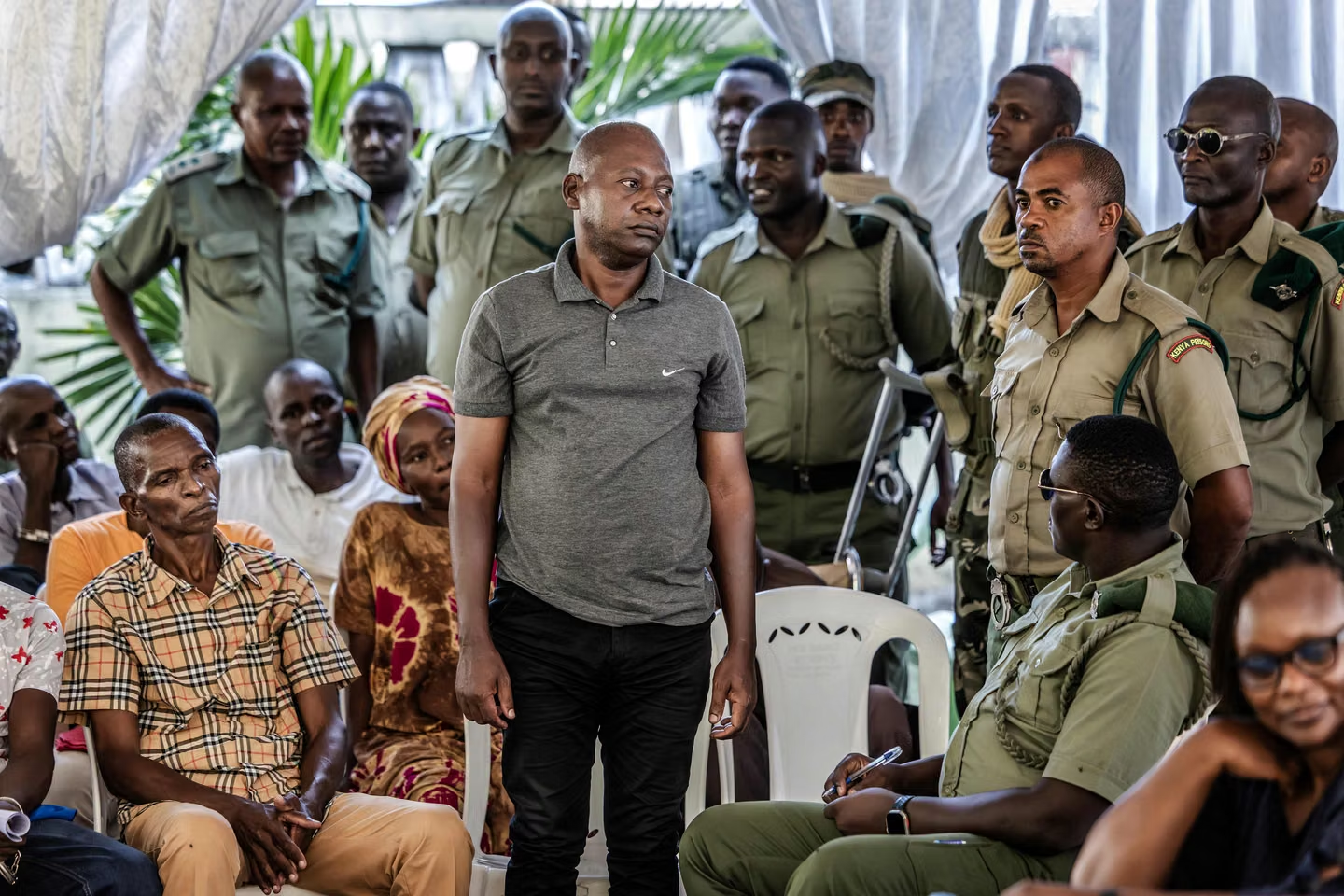
MOMBASA, November 06, 2026 (DAILYNWZ) — A Kenyan court has sentenced cult leader Paul Mackenzie to 200 years in prison for the starvation deaths of 190 children, in one of the country’s deadliest cases of mass killing linked to a religious group.
The sentence, delivered on Friday by Justice Diana Kavedza, comprises 100 years for murder by starvation and another 100 years for direct homicide. Mackenzie had denied the charges, arguing that he did not force his followers to starve, but the court rejected his defence.
Prosecutors said Mackenzie, who led an apocalyptic Christian church in a forest near Kenya’s Indian Ocean coast, ordered followers to stop eating and drinking, along with their children, so they could reach heaven before the end of the world. His accomplices allegedly used threats and beatings to enforce his instructions.
The victims’ bodies were found in shallow graves and latrines in Shakahola Forest. Some had been buried alive. Reading the judgment, Kavedza described how children watched their siblings die after days without food. Those who tried to take food or water were beaten, restrained and locked inside buildings used as makeshift fasting centres.
Twenty-eight accomplices were also sentenced, receiving prison terms ranging from 10 to 160 years. They had all been convicted at a trial last month. Defence lawyer Lawrence Obonyo, who represents Mackenzie and almost all the other defendants, said he would appeal the ruling.
The case came to light in April 2023, when police began exhuming bodies in Shakahola Forest, near the coastal town of Malindi. Although the trial covered the deaths of 190 children and one adult, the Kenya National Commission on Human Rights says 448 bodies were eventually recovered from the forest.
Mackenzie is also accused of ordering the deaths of 52 people found at another site in a village about 30 kilometres away. That case would bring the suspected death toll to 500. He has pleaded not guilty to those charges.
The scale of the killings has drawn comparisons with a doomsday cult in Uganda that killed more than 700 people in 2000 and the 1978 Jonestown massacre in Guyana, where more than 900 people died after a cult leader ordered followers to drink poison.
The ruling brought some relief to families, but many are still waiting for answers. Stephen Mwiti, whose six children were among the victims, said his wife had taken them to Shakahola, where they were starved to death. “Even if the adults had agreed to fast, what about the children?” he said before the sentencing.
Suleiman Zero, whose wife and six children remain missing, wept outside the court. “I am happy but where is my family?” he said, urging the government to help locate them or recover their bodies so he could bury them.
Mackenzie’s son, Dan, said he had escaped the group in his early teens after losing faith in its promises of heaven. He said he had also lost friends and a younger brother. “It’s justice to the people who we lost over there in Shakahola,” he said.
The case has raised questions about the authorities’ failure to act on earlier warnings. Police had investigated Mackenzie as early as 2017, and officials shut down his church in Malindi in 2019. He later moved his activities to Shakahola Forest.
Ojiro Odhiambo, head of rapid response at the Kenya Human Rights Commission, called the conviction an important step but said local administrators, police, intelligence officers and religious leaders must also be held accountable for failing to respond to repeated warning signs. Kavedza acknowledged institutional failures and urged parliament to take measures to prevent similar crimes. President William Ruto said in 2023 that he accepted responsibility for the government’s failure to prevent the deaths.
Despite calls for tighter oversight of religious groups, government-backed and Senate proposals to strengthen regulation have yet to become law.