
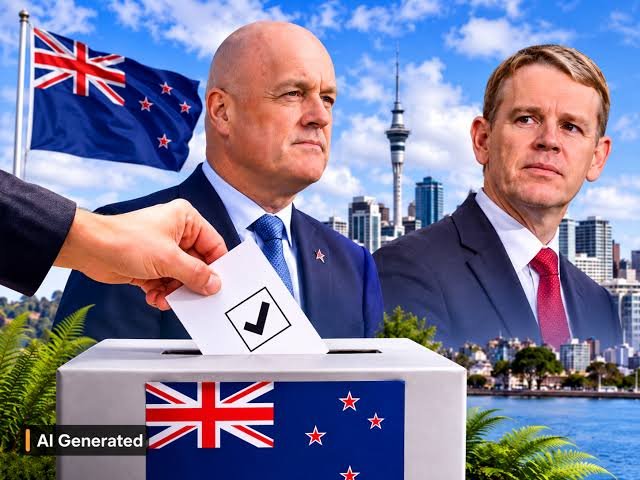
WELLINGTON, November 08, 2026 (DAILYNWZ) — New Zealand’s ruling National Party and the opposition Labour Party were separated by only a few thousand votes after more than 95% of ballots had been counted in Saturday’s general election, leaving the country’s political future uncertain and coalition negotiations likely to determine the next government.
Both centre-right National and centre-left Labour were polling just below 30% of the popular vote, according to preliminary Electoral Commission figures, in a contest shaped by economic difficulties and growing public disillusionment with the two main parties.
An Electoral Commission projection indicated that the three-party coalition led by Prime Minister Christopher Luxon could retain power with a narrow majority of just two seats. However, both major parties cautioned that the outcome remained too close to call.
Speaking to supporters in Auckland, Luxon welcomed the preliminary results, saying National appeared to have emerged as Parliament’s largest party and had a path towards forming the next government.
“But I have to tell you right now, it is too close to call,” he said.
Labour leader Chris Hipkins struck a similarly cautious tone at an election gathering in Upper Hutt, northeast of Wellington, telling supporters that further counting would be needed to establish the precise message delivered by voters.
The final outcome will remain uncertain until November 27, when official results are due to include special votes cast by overseas voters and people voting outside their electoral districts.
These ballots have historically favoured left-leaning parties, potentially shifting the balance against right-wing parties and proving decisive in closely contested constituencies.
New Zealand’s proportional electoral system makes coalition governments the norm. Introduced in 1996, the mixed-member proportional system combines votes for political parties with ballots for local constituency candidates. Parliament has 71 constituency seats and at least 49 party-list seats, with a majority required to form a government.
The election could also mark a significant political setback for National. Left-leaning parties are seeking to end the current coalition’s term in office and make it the first one-term government in just over 50 years.
Smaller parties are therefore expected to play a decisive role. If the National-led coalition loses its projected majority after the special votes are counted, either a right-leaning or a left-leaning bloc could need the support of the centrist Opportunity Party, which is on course to enter Parliament for the first time.
Opportunity leader Qiulae Wong said her party would negotiate with whichever political formation secured the largest number of seats in the official results, adding that a parliamentary majority would remain its guiding condition.
The close contest reflects historically weak support for both major parties, amid voter frustration over sluggish economic growth, strained household finances and ageing infrastructure.
New Zealand has been recovering slowly from a prolonged economic downturn, with unemployment reaching 5.7% in the third quarter, its highest level in 11 years.
Healthcare, hospitals and housing affordability also featured prominently in voters’ concerns, while Maori communities expressed opposition to government efforts to reverse longstanding policies aimed at improving their conditions and reduce the influence of the Treaty of Waitangi, the country’s founding document, on public policy.